



What is Chlorinated Paraffin and How Does it Differ from Normal Paraffin?
Chlorinated Paraffins (CPs) are a complex group of organic compounds based on alkane (paraffin) chains that have been controlled-substituted with chlorine atoms. These materials are widely utilized across multiple industries as additives, plasticizers, flame retardants, and metalworking fluids. In contrast, “normal paraffin” or refined paraffins lack chlorine atoms, exhibiting non-metallic, non-polar, and significantly lower reactivity characteristics.
This technical B2B article delves into the definitions of various chlorinated paraffins, production methods, physicochemical properties, industrial applications, quality control procedures, environmental considerations, and the key differences from normal paraffin. Additionally, sections on selection guidelines, packaging, export nuances, and mandatory documentation for international markets are provided. The technical insights are tailored for industrial buyers and suppliers, referencing the technical expertise of “Kimia Farayand Razi” (KFR) as an industry benchmark.
Types of Chlorinated Paraffins and Chlorination Degrees
Chlorinated paraffins are broadly categorized into three groups based on their carbon chain length and chlorine percentage:
- SCCP (Short Chain Chlorinated Paraffins): Carbon chain $C10-C13$, with a chlorine content typically ranging from $48-70\%$. This group is highly sensitive from an environmental regulatory perspective.
- MCCP (Medium Chain Chlorinated Paraffins): Carbon chain $C14-C17$, normal chlorine content $40-60\%$. Highly prevalent in metalworking fluids and plastics.
- LCCP (Long Chain Chlorinated Paraffins): Carbon chain $>C17$, with a variable chlorine percentage.
The type and degree of chlorination dictate the final physical properties, including density, viscosity, polarity, and thermal stability.
Production Method: Chlorination of Paraffins
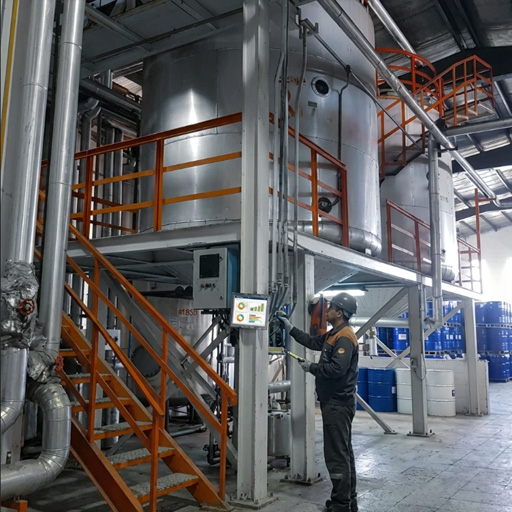
Chlorinated paraffin is generally produced by reacting refined paraffins with chlorine gas under the influence of light (UV) or heat. The reaction mechanism is predominantly the radical substitution of hydrogen with chlorine. Controlled parameters include temperature, chlorine flow rate, reaction time, and the presence of side-inhibitors to precisely adjust the chlorine percentage and chain distribution.
The process requires highly corrosion-resistant equipment and separation lines to remove hydrogen chloride and by-products. In the final stage, the product undergoes purification, neutralization, and rigorous quality control—a protocol strictly followed in the “Kimia Farayand Razi” laboratories as part of the official COA issuance.
Key Physicochemical Differences Between Chlorinated and Normal Paraffin
- Density and Molecular Weight: Chlorinated paraffin has a significantly higher density and molecular weight due to the heavy chlorine atoms.
- Polarity and Solubility: Chlorination makes the molecule relatively more polar. Therefore, CP is less soluble in common non-polar solvents and interacts much better with polar polymers and resins (like PVC).
- Viscosity and Boiling Point: The viscosity of chlorinated paraffin is remarkably higher, alongside an increased boiling point and thermal stability.
- Flammability: CPs are less volatile and inherently less flammable compared to light normal paraffins, acting effectively as flame retardants.
- Chemical Reactivity: The presence of chlorine alters the material’s behavior toward oxidation and hydrolysis, making it more reactive in the presence of strong bases or active metals.
These differences are the primary deciding factors for specific applications; for instance, if a flame retardant additive is required, the properties of CP offer a distinct advantage.
Industrial Applications of Chlorinated Paraffin
Due to its unique combination of physical and chemical traits, chlorinated paraffin is applied in the following sectors:
- Plasticizer and base oil in the production of PVC and other thermoplastics.
- Flame retardant additive in paint, resin, and rubber formulations.
- Heavy-duty metalworking fluids and metal cutting oils.
- Anti-corrosion agents and industrial lubricants.
Conversely, normal paraffins (such as light or heavy solid waxes and industrial petroleum jelly) are primarily used in candle making, product coating, packaging, and food/cosmetic applications (using appropriate grades). For a comprehensive look at industrial paraffin uses, review our article: What is Industrial Paraffin? Definition, Types, and Key Applications.
Quality Control and Technical Testing for Chlorinated Paraffin
QC for chlorinated paraffin encompasses specific tests:
- Chlorine Content Determination: Utilizing methods like microcoulometry, titration, or combustion-analytical techniques.
- Viscosity and Density: Measured at specified reference temperatures.
- Acid Number and Sulfur Content: To evaluate harmful contaminants and stability.
- Pour Point and Flash Point: To determine storage and transport behavior.
- Impurity Analysis: Profiling secondary components using GC, NMR, or spectroscopy.
To understand general paraffin QC parameters, refer to Paraffin Analysis: The Meaning of Brightness and Purity Percentage. Issuing a verified COA and MSDS for every batch prior to export is a fundamental industrial requirement.
Environmental Issues, Regulations, and Safety
Chlorinated paraffins, particularly SCCPs, are under strict international scrutiny due to their bioaccumulation potential and persistence in the environment; many are restricted under global conventions (e.g., Stockholm Convention). Exporters and buyers must be fully aware of destination-specific restrictions.
For export, documents such as a COA, MSDS, and often third-party inspections (like SGS) are mandatory. The technical guide Obtaining SGS Certification for Petroleum Exports: Technical Guide for Paraffin, Slack Wax, and Foots Oil is an excellent resource for exporters.
Controlled handling, adequate workplace ventilation, and proper waste management are essential safety protocols. Many global markets are now shifting toward safer alternatives or longer-chain grades (MCCP/LCCP) following thorough risk assessments.
Selection Between Chlorinated and Normal Paraffin — Industrial Guide
The right choice depends entirely on functional requirements:
- If the objective is “flame retardancy” or enhanced polarity and compatibility with specific resins, Chlorinated Paraffin is the optimal choice.
- If you require high purity, chemical inertness, and suitability for food or cosmetics, Normal Paraffin or White Mineral Oil is required. Review our BP-compliant analyses for medical and food-grade white oils at kfrco.com.
For selecting standard liquid paraffin for factory operations, read our Comprehensive Guide to Selecting Industrial Liquid Paraffin.
For packaging, candle making, and agriculture, non-chlorinated derivatives are preferred. Learn more in What is Slack Wax?.
Packaging, Logistics, and Export Guidelines
Appropriate packaging, technical datasheets, and adherence to customs standards are vital in the supply chain. Packaging must be moisture and corrosion-resistant. For exports to regions like Europe, pallets must meet ISPM-15 standards; see our guide: Wooden Pallet Packaging Standards for Export to the EU.
Export planning must include ready-to-present MSDS, COAs, and SGS inspection certificates. “Kimia Farayand Razi” possesses extensive practical experience in issuing technical documentation and preparing export packaging for international markets.
Alternatives and Sustainable Approaches
Given the environmental restrictions on certain CPs, the industry is actively seeking alternatives such as non-chlorinated plasticizers, synthetic oils, and polymer additives with similar profiles. Choosing an alternative depends heavily on the destination’s regulatory framework and required performance.
Furthermore, recycling waste containing chlorinated paraffins requires highly specialized processes, whereas recycling normal slack wax is a standard approach for waste reduction in other sectors.
Summary and Actionable Insights for Industrial Buyers
- Chlorinated paraffin is a substituted compound with specific chlorine percentages, offering drastically different physicochemical properties (density, viscosity, polarity) compared to normal paraffin.
- It is heavily utilized as a plasticizer, in metalworking fluids, and as a flame retardant.
- The choice between CP and normal paraffin must be driven by performance needs, environmental regulations, and supply chain reliability.
- Always request a COA, MSDS, and (if necessary) an SGS report to ensure quality and compliance.
To explore our range of standard refined paraffins, visit Refined Paraffin Products. The technical team at “Kimia Farayand Razi” is ready to consult on grade selection and documentation.
Conclusion
Chlorinated paraffin represents a highly specialized family of derivatives offering distinct properties for heavy industry, albeit with notable environmental and regulatory constraints. Making the right technical decision requires performance evaluation, strict QC, and regulatory compliance. “Kimia Farayand Razi,” as a specialized reference in paraffin supply, stands ready to assist in grade selection and export document preparation.
Frequently Asked Questions
How does the safety of chlorinated paraffin differ from normal paraffin?
Answer: Due to its chlorine content, CP behaves differently when exposed to heat, solvents, and oxidizers. Certain grades (especially SCCP) are environmentally and occupationally restricted, requiring specific MSDS guidelines and specialized handling.
How is the chlorine percentage in CP tested?
Answer: It is typically measured using microcoulometry or combustion-titration methods. Non-destructive techniques like XRF can also be utilized for rapid screening.
Is chlorinated paraffin suitable for food or cosmetic use?
Answer: No. CPs are strictly designed for technical and heavy industrial applications. Food and cosmetic uses require highly refined, non-chlorinated grades approved by BP/USP standards, such as Medical White Mineral Oil (see examples on kfrco.com).
What documents are required to export chlorinated paraffin?
Answer: Core documents include the COA, MSDS, and commercial shipping papers. Depending on the market, third-party SGS inspections and specific packaging compliance (like EU wooden pallets) may be mandatory. Check our guides on EU Pallet Packaging and SGS Export Certification.
Are there sustainable alternatives to CP?
Answer: Yes, depending on the application, non-chlorinated plasticizers, synthetic oils, or polymer additives can be used. Selecting the right alternative requires evaluating functional performance and destination regulations.
Precise Industrial Decisions Start with Technical Selection ⚙️
When it comes to “Chlorinated Paraffin vs. Normal Paraffin” or selecting Refined Paraffin, Industrial Vaseline, Slack Wax, or Foots Oil, price isn’t the only decision-making factor. What truly matters is consistent quality, transparent technical specifications, and a reliable supply chain. With an engineering approach, documented quality control, and export expertise, Kimia Farayand Razi turns your selection into a dependable industrial decision.
Professional decisions mean reduced risks, consistent quality, and long-term partnerships.