
Description
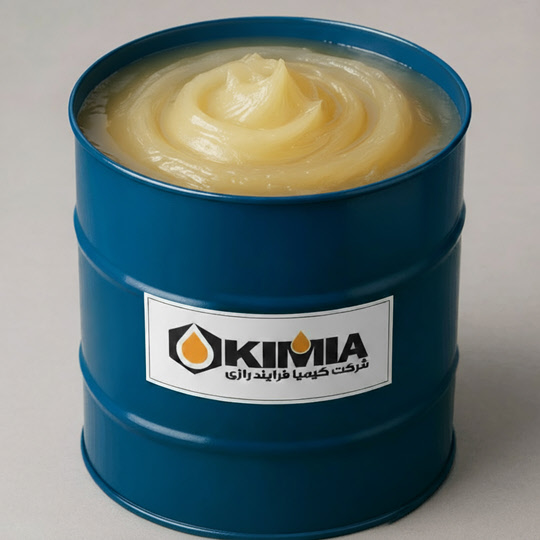
Foots Oil, sometimes referred to as paraffin residue wax, is a highly valuable byproduct generated during the manufacturing of fully refined paraffin wax from Slack Wax. Essentially a mixture of base oil and low-melting-point waxes, its highly economical pricing and unique physical properties have transformed it into a strategic raw material for industries requiring bulk, cost-effective inputs. Moving away from the traditional view of being mere “waste,” Foots Oil is recognized today as a highly functional additive with specific industrial applications.
For production managers, formulation engineers, and procurement specialists in the wood panel, agricultural, and chemical sectors, a precise understanding of this material’s technical specifications is the key to reducing production costs without compromising final product quality. Selecting the appropriate grade of Foots Oil can enhance the waterproofing properties of particleboard or effectively prevent the caking of chemical fertilizers. This guide provides a comprehensive technical analysis of this product and its diverse applications.
Technical Analysis and Chemical Structure of Foots Oil
The quality and efficiency of Foots Oil depend directly on its origin and the strict control of its physical parameters. The dual nature of this product—the simultaneous presence of an oil phase and a wax phase—grants it unparalleled properties.
Origin and Production Process
To understand the nature of this product, we must look at the core of the paraffin production process. Foots Oil is the direct result of separating oil from wax, and its properties reflect this very procedure.
A Byproduct of the Slack Wax De-oiling Process
The primary raw material for paraffin production is Slack Wax, a mixture of wax and a high percentage of oil (up to 35%35\%35%). During the de-oiling (or sweating) process, Slack Wax is mixed with solvents such as Methyl Ethyl Ketone (MEK) and chilled to crystallize the wax. After filtration, the solid phase (paraffin) is separated. The remaining liquid phase—a combination of solvent, oil, and some dissolved wax—is sent to the solvent recovery unit. Once the solvent is entirely removed, the final product is Foots Oil.
The Significance of Oil Content as a Key Quality Indicator
The most critical parameter in determining the grade and application of Foots Oil is its Oil Content. This parameter can range from 15%15\%15% to over 50%50\%50%.
- High Oil Content Foots Oil: More liquid with lower viscosity. It is highly suitable for applications requiring spraying or high penetration, such as dust control on surfaces.
- Low Oil Content Foots Oil: Exhibits a paste-like or semi-solid state with a thicker consistency. It is utilized in applications that require the formation of a thicker layer, such as in the polish or rubber manufacturing industries.
Defining Physical and Rheological Characteristics
The physical specifications of this product dictate its behavior under various processing and environmental conditions.
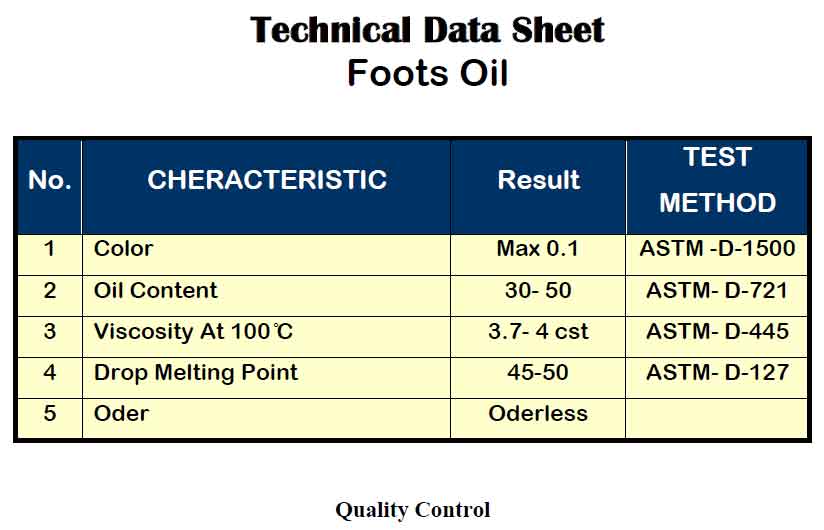
| Technical Specification | Typical Range | Importance in Industrial Applications |
|---|---|---|
| Oil Content (ASTM D721) | 15%−50%15\% – 50\%15%−50% | Primary parameter defining grade and application. |
| Pour Point (ASTM D97) | 10−40∘C10 – 40^\circ \text{C}10−40∘C | Determines low-temperature fluidity and ease of transport. |
| Flash Point (ASTM D92) | >180∘C> 180^\circ \text{C}>180∘C | Key safety indicator for storage and hot processes. |
| Kinematic Viscosity at 100∘C100^\circ \text{C}100∘C | 5−15 cSt5 – 15 \text{ cSt}5−15 cSt | Impacts spraying, penetration, and lubrication properties. |
| Color | Light Yellow to Dark Brown | Generally of low importance in industrial applications. |
Viscosity and Consistency Across Temperatures
The viscosity of Foots Oil depends on its oil content and temperature. This parameter is of high importance in applications such as emulsion production for the particleboard industry or spraying on chemical fertilizers, as it directly affects droplet size and coating uniformity.
Pour Point and Flash Point
The Pour Point is the lowest temperature at which the product still flows. This is crucial for winter storage and pumping. The Flash Point acts as a safety metric, indicating the lowest temperature at which the product’s vapors will ignite in the presence of an ignition source; it must be considered during all stages of transport, storage, and usage.
Color and Impurities
The color of Foots Oil typically ranges from light yellow to brown, depending on the quality of the initial feedstock (Slack Wax) and the refinement process. Since this product is used in industries where color is not a sensitive factor, it is generally not a primary purchasing criterion.
Industrial Applications and Economic Considerations
The main advantage of Foots Oil is its significantly lower price compared to base oils or pure paraffin. This economic benefit makes it an attractive option for high-volume applications.
Application Scenarios in Key Industries
The unique combination of oil and wax provides diverse functional properties for this product.
The Wood Panel Industry: Waterproofing Agent for MDF and Particleboard
In the production of compressed wood panels like particleboard and MDF, Foots Oil (or paraffin) emulsion is used as a hydrophobic agent. This emulsion is mixed with the resin and sprayed onto the wood chips. During the hot-pressing phase, the wax particles melt and create a thin, waterproof coating throughout the board’s structure. This prevents the board from swelling due to moisture and increases its dimensional stability.
Match Manufacturing, Polishes, and Rubber Industries
- Match Manufacturing: Matchsticks are dipped in molten Foots Oil to ensure they burn slowly and evenly.
- Polishes and Waxes: Serves as a softener and volume enhancer in the production of shoe polishes and industrial waxes.
- Rubber Industry: Utilized as a cost-effective softener and processing aid in certain rubber compounds.
Key Considerations for Purchasing and Optimal Use
When purchasing Foots Oil, obtaining a Certificate of Analysis (COA) from the supplier is essential to verify the oil content, viscosity, and pour point. Consistency in quality between different batches is the most important indicator of a reliable supplier, as fluctuations in these parameters can severely disrupt your production process.
Ultimately, Foots Oil is a prime example of transforming a byproduct into a highly valuable raw material. With a precise understanding of its properties and by selecting the correct grade, industries can effectively manage their costs and boost productivity. To ensure you receive Foots Oil with consistent quality and to get technical consultation on selecting the right grade for your specific industry, the experts at Kimia Farayand Razi are ready to provide detailed analyses and competitive quotes.



Reviews
There are no reviews yet.