
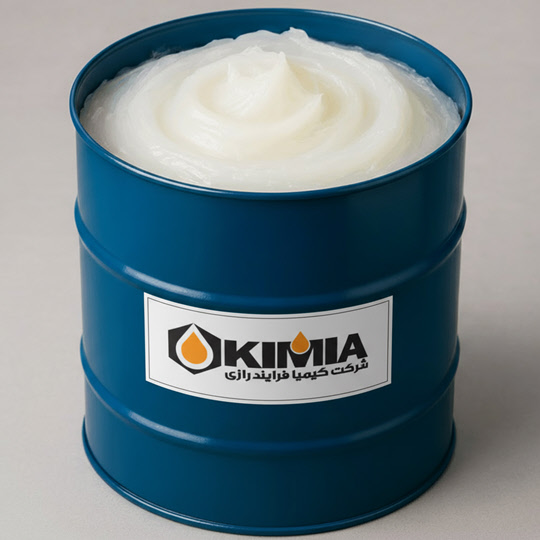
Description
Industrial Petroleum Jelly, scientifically known as Petrolatum, is a semi-solid, amorphous, and hydrophobic mixture derived from the heavy distillation of petroleum. Renowned for its unique properties—such as high water resistance, chemical inertness, and the ability to create a stable protective barrier—it has become one of the most widely used materials in various heavy and light industries.
While public perception often associates “Vaseline” only with cosmetic use, the Industrial Grade plays a critical role in equipment maintenance, component protection, and manufacturing optimization. For maintenance engineers, production managers, and formulation specialists, a deep technical understanding of this material’s specifications is key to selecting the correct grade and maximizing its functional potential.
Technical Analysis and Chemical Structure of Petrolatum
The quality and performance of industrial petroleum jelly are directly linked to its chemical composition and physical properties. This complex compound exhibits specific behaviors under varying thermal and mechanical conditions that dictate its industrial efficacy.
Chemical Composition and Manufacturing Process
Petrolatum exists on the boundary between heavy oils and microcrystalline waxes, inheriting properties from both.
Semi-Solid Structure: A Matrix of Oil and Microcrystalline Wax
The structure of industrial petroleum jelly consists of a three-dimensional matrix of microcrystalline waxes that trap large amounts of mineral oil within their lattice. This gel-like structure is responsible for its semi-solid consistency and its ability to adhere firmly to surfaces. Unlike the linear structure of paraffin, the long-chain and branched hydrocarbons in microcrystalline wax prevent the formation of large crystals, giving the product a smooth and uniform texture.
Distinguishing Industrial Grades from Cosmetic and Pharmaceutical Grades
The primary difference between Industrial Petroleum Jelly and Cosmetic or Pharmaceutical grades lies in the degree of refining. Industrial grades are engineered for applications where physical properties like lubrication and corrosion protection are the priority. Consequently, they may exhibit a darker color (ranging from yellow to brown) and a mild characteristic petroleum odor. In contrast, cosmetic grades undergo intense purification (such as hydrotreating and activated carbon filtration) to become entirely colorless, odorless, and free of polycyclic aromatic hydrocarbons (PAHs).
Physicochemical Parameters and Industrial Significance
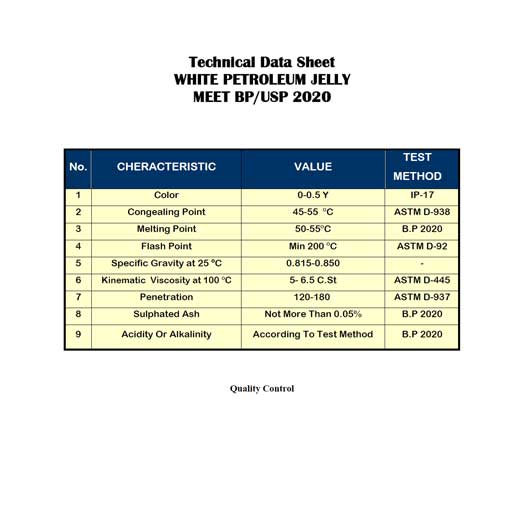
Selecting the appropriate grade requires evaluating key parameters typically listed in the Product Certificate of Analysis (COA).
| Technical Specification | Typical Range | Industrial Significance |
|---|---|---|
| Drop Melting Point (ASTM D127) | 45−65∘C45 – 65^\circ\text{C} | Determines the maximum operating temperature before flow occurs. |
| Cone Penetration (ASTM D937) | 100−200 dmm100 – 200 \text{ dmm} | Indicates consistency; crucial for coating ease and pumpability. |
| Color (ASTM D1500) | 2.0−7.02.0 – 7.0 | Reflects refinement level; less critical for non-aesthetic applications. |
| Kinematic Viscosity at 100∘C100^\circ\text{C} | 5−12 cSt5 – 12 \text{ cSt} | Affects the thickness of the lubricating film and sealing ability. |
Drop Melting Point and Thermal Stability
This parameter indicates the temperature at which the jelly begins to flow through a standard orifice. The drop point is a key indicator for determining the maximum service temperature. For instance, when lubricating parts that generate heat during operation, a grade with a melting point higher than the operating temperature must be used.
Cone Penetration and Consistency Testing
This test measures the hardness or softness of the petroleum jelly. A higher penetration number signifies a softer product, while a lower number indicates a harder consistency. Softer grades are ideal for coating complex surfaces and applications requiring penetration into crevices, whereas harder grades are used to create a thick, stable protective layer.
Strategic Applications and Grade Selection Guide
Due to its cost-effectiveness, accessibility, and high performance, Industrial Petroleum Jelly has become a multi-purpose solution across numerous sectors.
Application Scenarios in Leading Industries
The protective and lubricating properties of this product make it ideal for:
1. Metal Corrosion and Rust Prevention
The most vital application of industrial petrolatum is corrosion inhibition. By creating a hydrophobic physical barrier, it prevents moisture and oxygen from reaching the metal surface.
- Storage: Coating metal spare parts, tools, and machinery for long-term warehousing.
- Automotive: Protecting vehicle battery terminals against sulfation and corrosion.
- Manufacturing: Temporary coating of metal surfaces between different production stages.
2. Lubrication, Sealing, and Assembly
Petrolatum performs exceptionally well as a lubricant in low-speed, low-load systems. It is also used as an assembly aid for plastic and rubber components (such as O-rings) to prevent tearing and damage. Its sealing properties are beneficial for filling voids and preventing water ingress in electrical and mechanical connections.
Safety, Storage, and Optimized Procurement
When handling Industrial Petroleum Jelly, the use of Personal Protective Equipment (PPE) such as gloves is recommended. The product should be stored in closed containers, away from direct sunlight and heat sources, to prevent oxidation and degradation of properties.
When purchasing, always review the COA to ensure the physical parameters (especially the melting point and penetration) align with your specific industrial requirements.
As a high-value and economical raw material, the correct selection of petroleum jelly can significantly extend equipment lifespan and reduce maintenance costs. For technical consultation regarding grade selection and to receive a competitive quote for bulk inquiries, the experts at Kimia Farayand Razi are ready to assist you.



Reviews
There are no reviews yet.